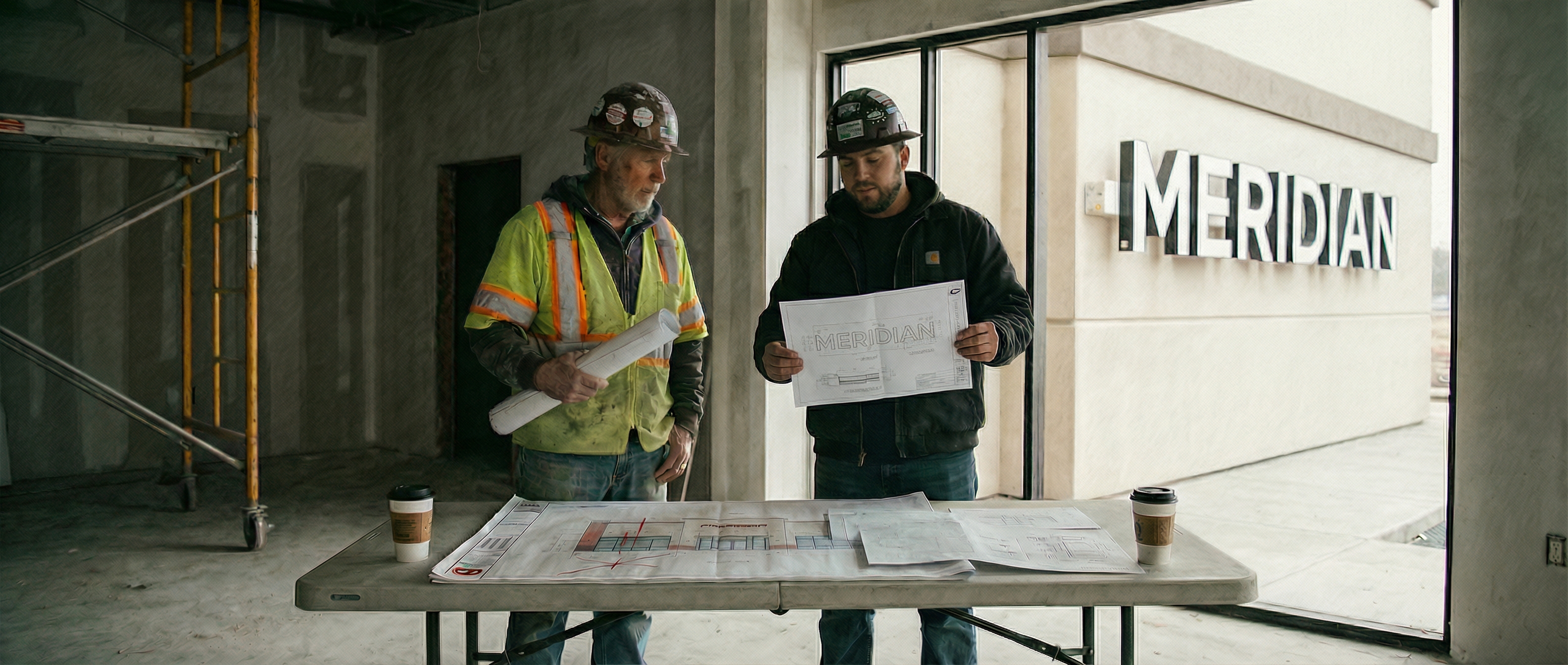
Why Sign Fabricators and Architects Don't Always Speak the Same Language
"Provide illuminated signage per elevation drawings." I've read that line on hundreds of CD sets. And every time, it kicks off the same cycle: the sign company bids on what they think it means, the architect expects something different, an RFI gets filed, and two weeks evaporate while everyone clarifies terms that both sides thought were already clear.
"Provide illuminated signage per elevation drawings."
I've read that line on hundreds of CD sets. And every time, it kicks off the same cycle: the sign company bids on what they think it means, the architect expects something different, an RFI gets filed, and two weeks evaporate while everyone clarifies terms that both sides thought were already clear.
Architects understand signs fine. Fabricators understand construction documents fine. But these two professions developed their vocabularies independently, in parallel, for decades. Same words, different meanings. And nobody ever wrote the dictionary that connects them. This post is an attempt at that dictionary.
WHERE THE WIRES CROSS
Architects work in a system built around CSI divisions, specification sections, and a documentation language refined over generations. Sign fabricators work in a system built around shop drawings, material callouts, and a production vocabulary that evolved on fabrication floors. When these systems meet on a project, there's a translation gap that neither side fully sees until it shows up as an RFI.
A few years ago I counted the RFIs on a mixed-use project where we handled the signage package. Eleven RFIs. Eight of them came down to terminology mismatches, not actual design conflicts. Eight clarifications that cost the project roughly four weeks total. That's not unusual, in fact, it's the norm.
THE GLOSSARY NOBODY WROTE
Here's where the disconnect lives, term by term.
- "Signage" vs. "sign." In CD sets, "signage" often refers to the entire sign program, interior and exterior, wayfinding, identification, code-required, decorative, all of it. On the fabrication floor, that word is almost never used. Fabricators talk about individual signs: the monument, the channel letters, the suite plaques, the ADA signs. When an architect writes "signage to be coordinated with owner," the fabricator reads it as "someone else is figuring out what the signs actually are." When a fabricator says "we need the sign spec," the architect might point to a line in Division 10 that says "refer to signage package" and consider that handled.
- "Elevation" vs. "shop drawing." Architects produce elevations that show the sign in context, on the building, at scale. Fabricators produce shop drawings that show the sign in isolation, with every dimension, material, finish, mounting detail, and electrical connection spelled out. These are fundamentally different documents solving different problems, and neither one replaces the other. But I've been on projects where the architect assumed the shop drawing was a markup of their elevation, and projects where the fabricator assumed the elevation was the only drawing they'd need to reference.
- "Raceway" vs. "wireway." This one bites people constantly. In sign fabrication, a raceway is a rectangular metal box mounted to a building face that houses the electrical connections for channel letters and provides the mounting surface. In electrical work (and in NEC code language), a raceway is any enclosed conduit for wiring. When the electrical engineer writes "raceway" on the MEP drawings, they're talking about conduit. When the sign company writes "raceway" on the shop drawing, they're talking about a visible aluminum box on your building. Same word. Completely different object. I've seen this one cause genuine confusion at installation when the electrician shows up expecting to pull wire through conduit and finds a 24-inch-tall painted box bolted to the parapet.
- "Illuminated." To an architect, this often means "the sign lights up." To a fabricator, this is where the conversation starts. Front-lit, halo-lit, edge-lit, backlit, internally illuminated, externally illuminated by gooseneck or ground-mounted fixtures. Each method has different power requirements, different depth profiles, different mounting conditions, and different costs. A channel letter set that's front-lit and a channel letter set that's halo-lit might look similar on an elevation but require completely different electrical layouts and wall conditions. Specifying "illuminated" without the method is like specifying "flooring" without the material.
- "Monument sign" vs. "ground sign." Architects and planners tend to use "monument sign" to describe any freestanding sign at or near grade. Fabricators use it more narrowly: a sign where the base is as wide (or nearly as wide) as the sign face, sitting directly on grade or a short foundation. A sign on two poles is a pole sign. A sign on a single column might be a pylon. These distinctions matter because they carry different structural engineering requirements, different foundation specs, and different cost profiles. When the CD set says "monument sign" and the fabricator reads it as something specific, but the architect actually meant a pylon, the structural engineer's calculations don't apply and you're back to square one.
- "ADA signage" vs. "code-required signage." ADA signs are a specific subset of code-required signs. They have tactile lettering, Grade 2 Braille, specific mounting heights (60 inches to the centerline on the latch side of the door), and non-glare finishes. But code-required signage also includes exit signs, fire evacuation maps, occupancy load signs, and stairwell identification, none of which follow ADA tactile standards. When a spec says "all code-required signage per ADA," it conflates two categories. Fabricators catch this and file an RFI. That RFI takes a week to resolve, and the answer is always the same: ADA tactile signs on the rooms, standard code signs everywhere else.
- "Fascia" vs. "building face." In architecture, the fascia is the vertical face of a roof edge or soffit. In sign work, "fascia sign" sometimes gets used loosely to mean any sign mounted flat to a building wall, whether it's on the actual fascia, the parapet, the storefront header, or the side of the building. When an architect says "signage on the fascia," they mean the fascia. When a sign company says "fascia-mounted sign," they might mean the wall above the storefront. When landlord criteria says "fascia signage only," they usually mean flat-mounted to the building face, no projecting or perpendicular signs. Three different uses of one word, three different mounting conditions.
WHY THIS KEEPS HAPPENING
Neither side is wrong. Both vocabularies make perfect sense within their own disciplines. Architects use precise terms from a documentation system designed for buildings. Fabricators use precise terms from a production system designed for signs. The gap exists because signage sits at the intersection of those two worlds and belongs fully to neither.
CD sets are written to communicate with contractors, engineers, and code officials. They're not written to communicate with sign fabricators, and there's no reason they would be. Sign fabrication lives in a weird spot, partly Division 10 (Specialties), sometimes Division 26 (Electrical) for the power, occasionally referenced in Division 5 (Metals) for structural supports. It doesn't have a clean home in the spec structure, and the terminology reflects that.
Sign companies, meanwhile, developed their language on shop floors and in sales conversations. "Raceway" has meant the same thing in every sign shop for 40 years, and the fact that it means something different to an electrician doesn't come up until the install.
THE FIX
A better spec template won't fix this, and neither will a longer terminology section in the project manual. The fix is a conversation that happens before the CD set goes to bid.
When we work on projects with architectural teams, we ask to review the sign-related spec language before it goes out. Not to redesign anything. Just to flag the terms that will generate RFIs and suggest clarifying language. "Illuminated channel letters, front-lit" instead of "illuminated signage." "Freestanding sign, single-column pylon type" instead of "monument sign." "ADA-compliant tactile room identification signs" instead of "ADA signage."
This takes an hour. Maybe two for a large project. And it eliminates weeks of RFI cycles during construction, when the clock is actually running and every clarification costs real schedule time.
The other half of the fix is for fabricators to stop assuming that architects should know sign terminology. They shouldn't have to. The architect designed the building. The sign company needs to translate their own language into the project's language, clearly and without condescension, on every shop drawing and every submittal.
Both sides are precise professionals with exact vocabularies. The only thing missing is the translation layer between them. That layer doesn't need to be complicated, it just needs to exist.
Keep reading
Design for the maintenance workers
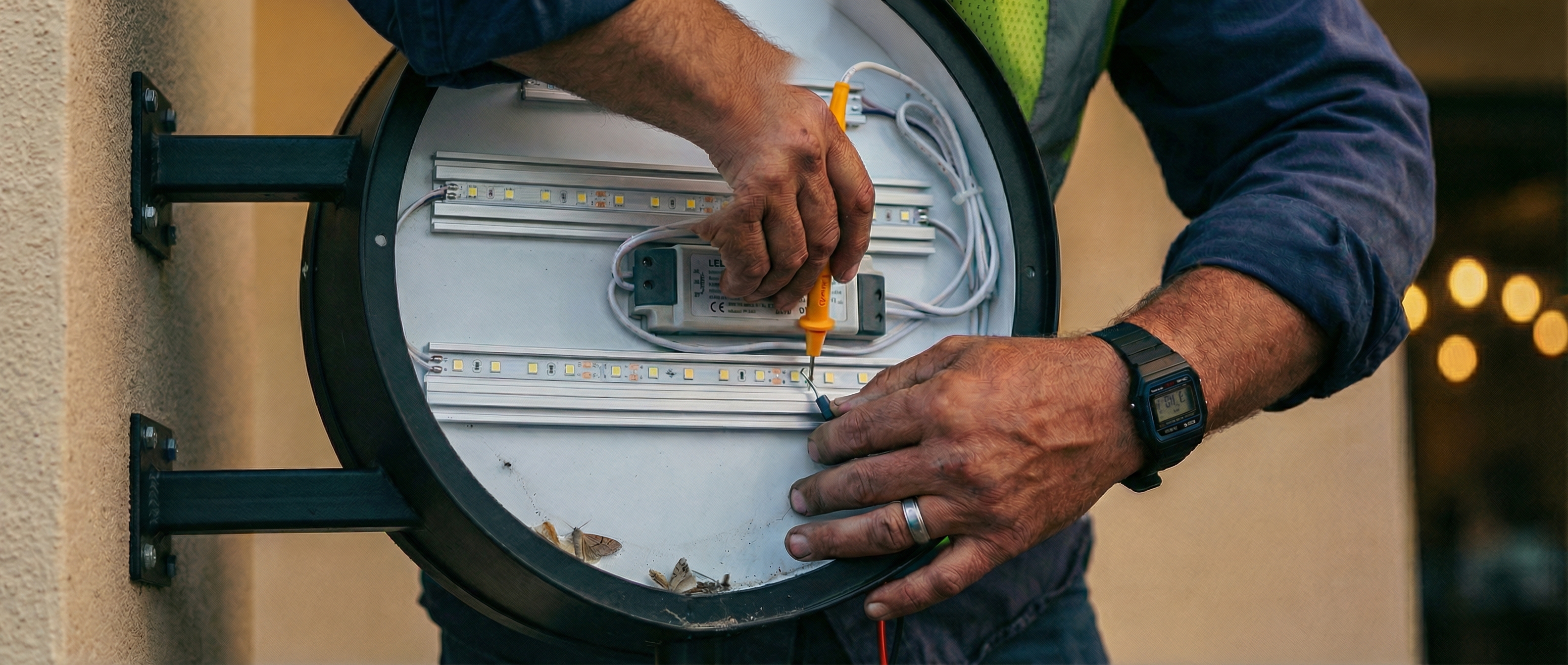
We ask this on every project now: how does this sign get opened, cleaned, and serviced without shutting down a hallway, blocking traffic, disassembling half of it in the field, or removing it entirely?
Why old signs feel like they're more honest
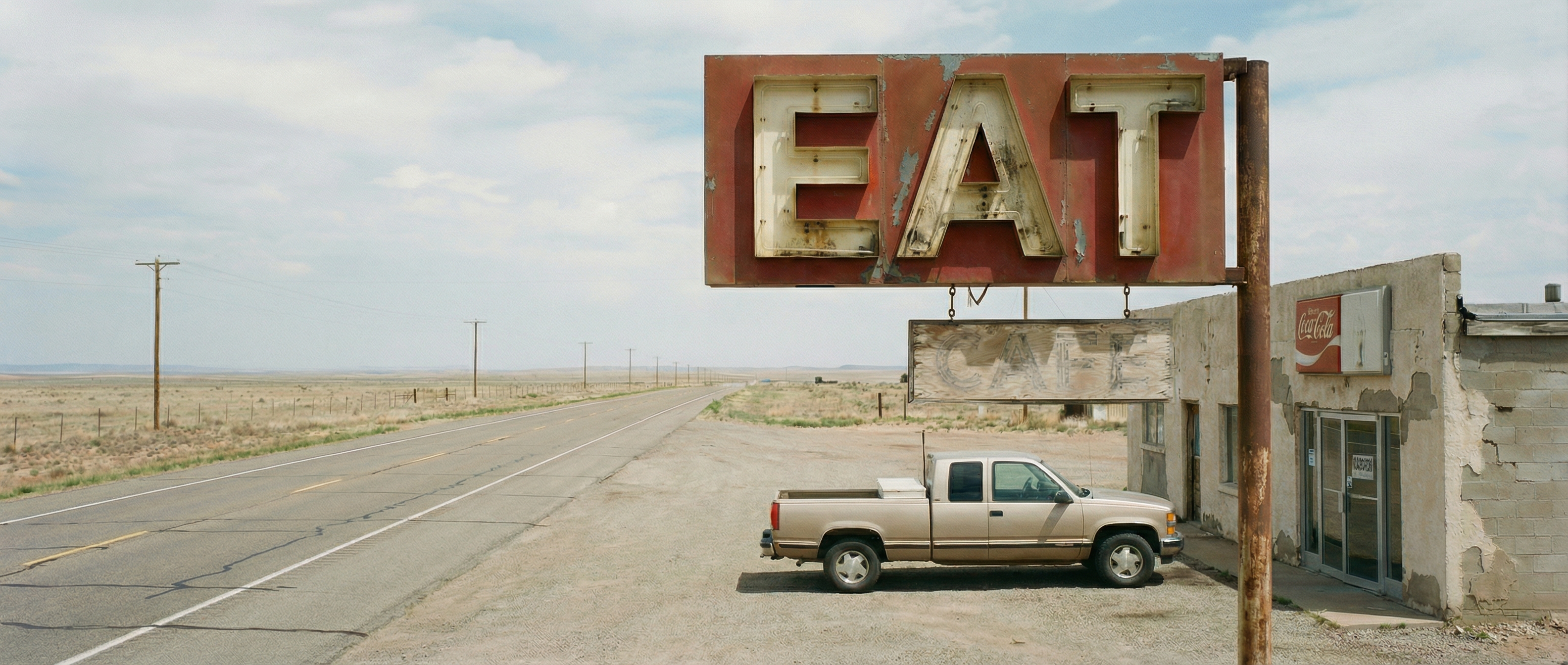
Old signs didn't have brand strategy. They didn't have design systems or mood boards or a 46-page identity guide specifying corner radius and exclusion zones. They had a message and a budget. "MOTEL." "GAS." "VACANCY." "COLD BEER."
Design for the person who's already late and slightly panicked
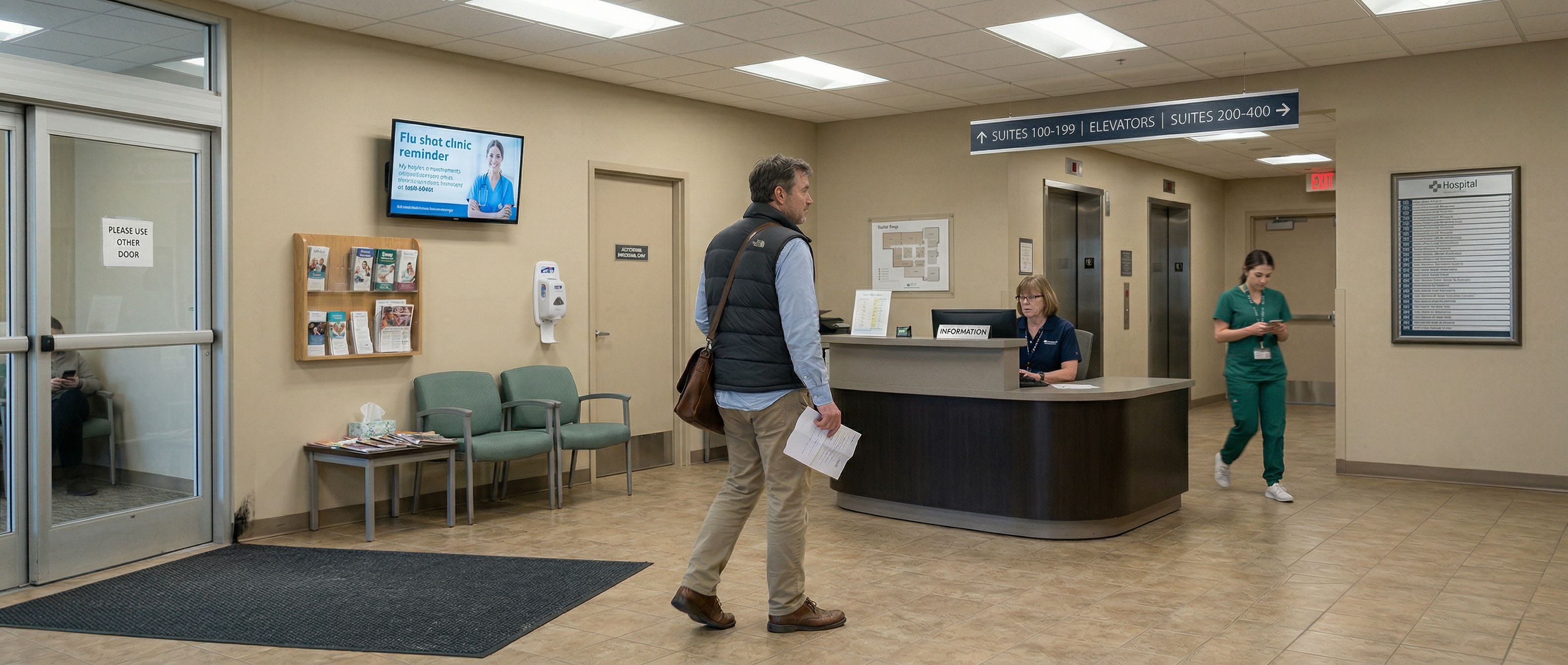
Most wayfinding systems are designed for a person who doesn't exist. Someone calm, focused, walking at a moderate pace with nothing on their mind except getting from point A to point B. Someone who stops at the directory, reads it line by line, and proceeds with full confidence.
Good signage
starts with a conversation.
Every project is different. Let’s talk about yours.