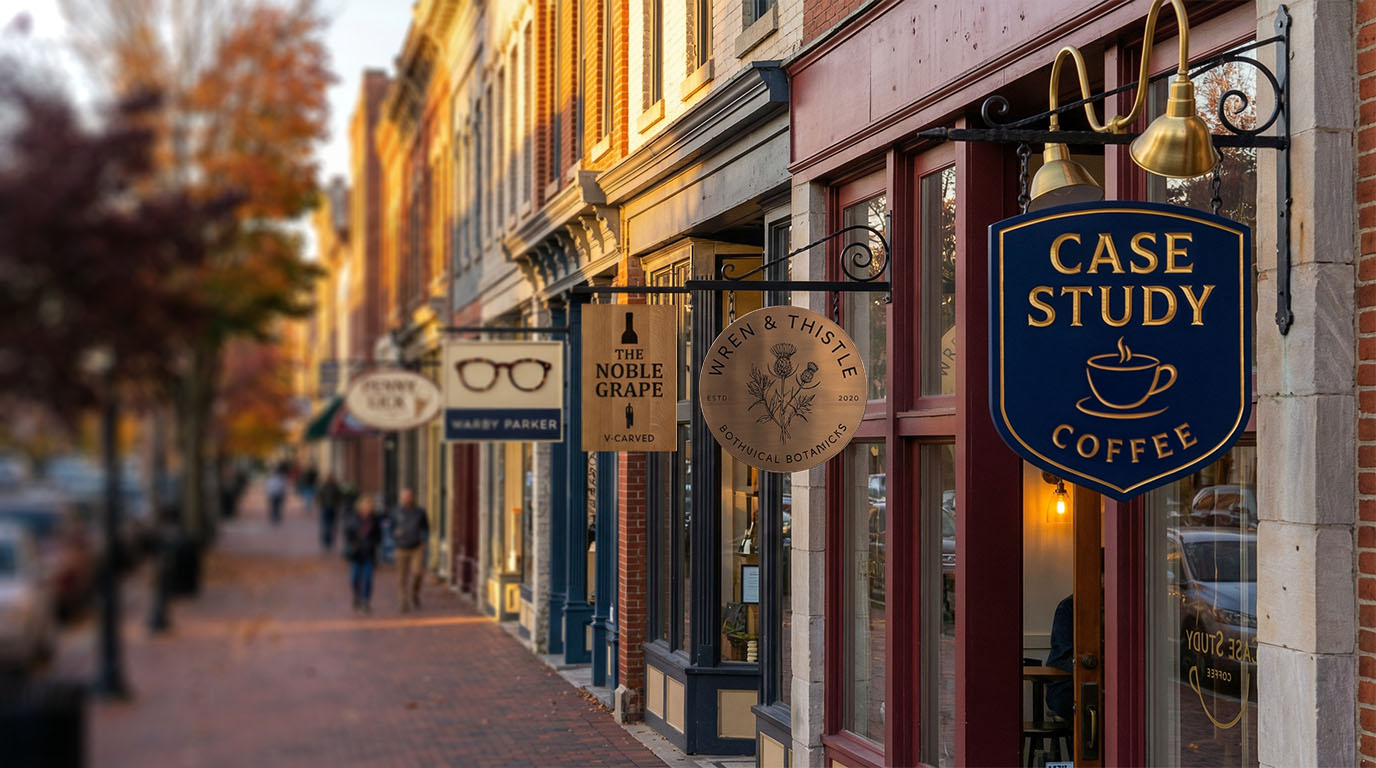
Blade signs are the most architecturally respectful sign type. Fight us.
Every sign type has a job. Channel letters dominate retail strips because they're legible at distance and they light up. Monument signs anchor campuses and give multi-tenant properties a presence from the road. Wall cabinets work when you need maximum visibility and you've got the facade real estate for it. We've designed all of them, thousands of times, and they all have their place.
THE CASE
Every sign type has a job. Channel letters dominate retail strips because they're legible at distance and they light up. Monument signs anchor campuses and give multi-tenant properties a presence from the road. Wall cabinets work when you need maximum visibility and you've got the facade real estate for it. We've designed all of them, thousands of times, and they all have their place.
But blade signs do something none of the others do. They announce a business without covering up the building.
A blade sign, the kind that sticks out perpendicular from the building face, occupies a completely different plane than every other sign type. It hangs from a bracket, sits in the narrow vertical space between the facade and the streetscape, and reads at pedestrian scale from both directions of foot traffic. It doesn't compete with the architecture. It tucks into it.
Old downtowns, historic districts, European streets. Blade signs everywhere, and the buildings still look like buildings. That's not a coincidence.
WHY THEY WORK
A flat wall sign is only visible to people standing directly in front of it. That's fine if your storefront faces a parking lot and all your traffic is approaching head-on. But on a sidewalk, in a downtown, on a main street where people are walking parallel to the building, a wall sign is edge-on. Nearly invisible.
A blade sign catches that parallel traffic. Someone walking down the street sees it from a block away, from both directions, without having to turn and face the building. For pedestrian-heavy environments, that's a real visibility advantage, and most people don't think about it until you point it out.
They also work beautifully on buildings with narrow storefronts. If you've got a 15-foot-wide shop front, a wall sign has to be small to stay proportional, and small means easy to miss. A blade sign can be tall, visually substantial, and still only occupy a few inches of the facade width. You get presence without domination.
THE ARCHITECTURE ANGLE
Architects spend months on a facade. Materials, proportions, reveals, rhythm. Then a tenant puts up signage and, depending on the sign type, it can either honor that work or stomp all over it. That's not the tenant's fault or the sign company's fault. Some buildings just aren't designed with signage in mind, and the available mounting options force compromises.
Blade signs tend to create fewer of those compromises. They're small in footprint, they mount on brackets that can be designed to match the architectural character, and they don't obscure fenestration or material patterns. A 24-inch blade sign on a decorative bracket, hanging at 9 feet, lit from behind or above, scaled to the storefront... it looks like it belongs there. It looks like someone thought about it.
This is why historic districts and design overlay zones love them. Many of those codes restrict or prohibit projecting box signs and internally illuminated channel letters but specifically encourage blade signs. The regulators figured out what we've been saying for years: blade signs play nice with buildings.
WHAT TO KNOW
They're not right for every situation. If your primary traffic is vehicular at 45 mph, a blade sign probably isn't your best bet as a primary identification sign. It's a pedestrian-scale tool. On a highway-fronting strip center, channel letters or a monument sign will do more work. Blade signs shine on main streets, downtown corridors, mixed-use developments, and anywhere foot traffic matters.
Mounting requires some thought. The bracket has to be engineered for wind load, especially if you're in a coastal or high-wind area. The sign itself needs to be lightweight relative to its size, which usually means aluminum construction with either push-through or painted graphics. Illumination options include halo-lit (backlit off the wall), externally lit with a gooseneck or spotlight, or internally illuminated if the code allows it. Each gives a different feel. Halo-lit blade signs at night are genuinely beautiful, and we don't say that about a lot of sign types.
Size matters more on blades than on almost any other sign type. Too big and it looks like a billboard hanging off the building. Too small and nobody sees it. The sweet spot for most retail storefronts is somewhere between 18 and 30 inches wide, with a height that's proportional to the storefront bay. Getting that proportion right is the difference between a blade sign that flatters a facade and one that just kind of dangles there.
THE HILL
We're obviously biased. We love designing these things. There's something satisfying about a sign that improves the look of a building instead of just attaching to it. But the bias comes from watching them work, project after project, in exactly the environments where other sign types struggle to be both visible and respectful.
If you're on a pedestrian street, in a historic district, or on a building with architecture worth preserving, blade signs deserve a serious look. They're not the loudest option, but they are the smartest one, and we will die on this hill.
Keep reading
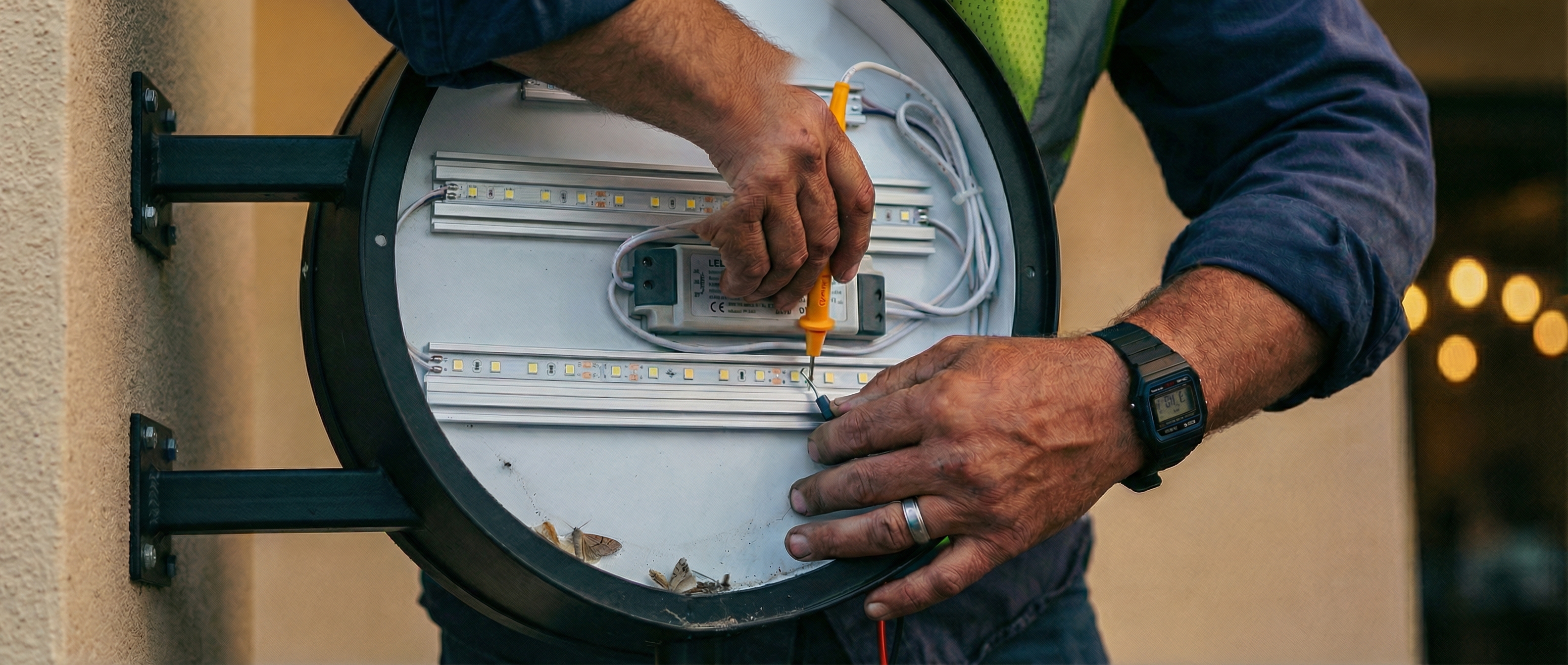
Design for the maintenance workers
We ask this on every project now: how does this sign get opened, cleaned, and serviced without shutting down a hallway, blocking traffic, disassembling half of it in the field, or removing it entirely?
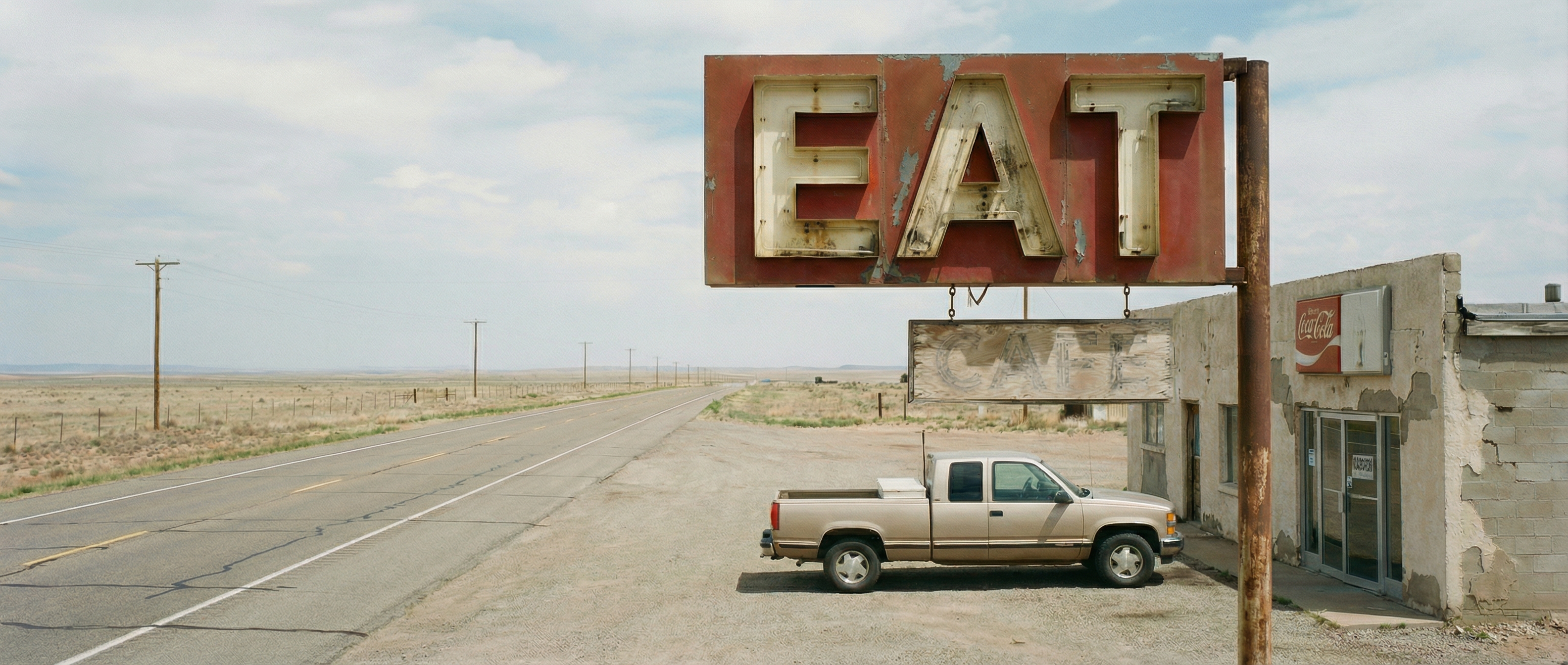
Why old signs feel like they're more honest
Old signs didn't have brand strategy. They didn't have design systems or mood boards or a 46-page identity guide specifying corner radius and exclusion zones. They had a message and a budget. "MOTEL." "GAS." "VACANCY." "COLD BEER."
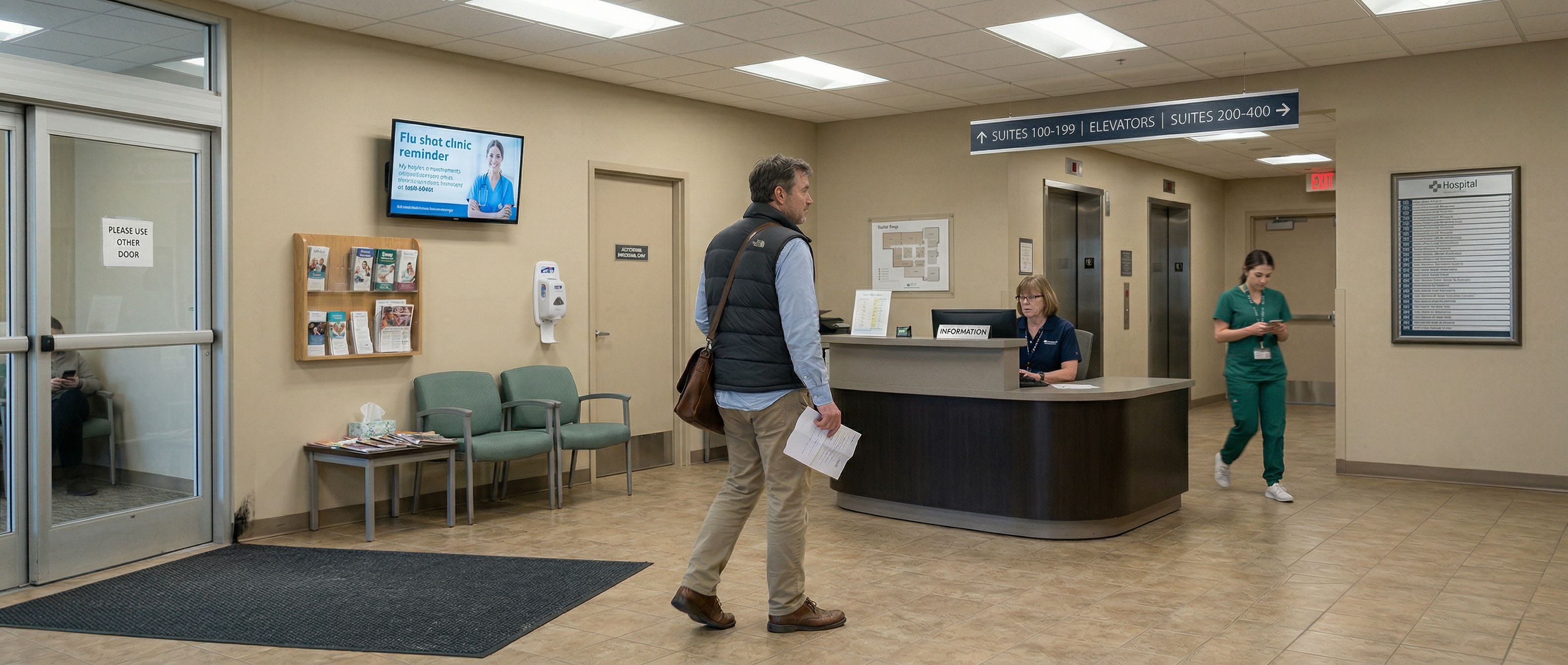
Design for the person who's already late and slightly panicked
Most wayfinding systems are designed for a person who doesn't exist. Someone calm, focused, walking at a moderate pace with nothing on their mind except getting from point A to point B. Someone who stops at the directory, reads it line by line, and proceeds with full confidence.
Good signage
starts with a conversation.
Every project is different. Let’s talk about yours.